Women’s work: Cicely Phillips (far left), a maid at the Royal York and a former lance colonel in the Guyanese army, helped lead a protest last September. (Photograph by Cristal Cruz-Haicken)
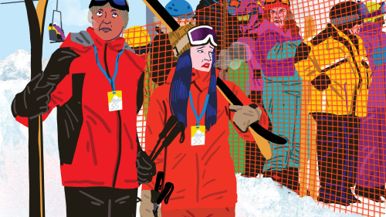

Near the bottom of the hierarchy are people like Cicely Phillips. When she first arrived in Toronto in 1992, Phillips had no idea what she was getting herself into. She flew in from Guyana in February wearing her finest clothes, shocked to discover that the Canadian winter had lingered so late into the new year. The city was a mystery to her. She found a job cleaning rooms at the Royal York through a friend who worked there as a housekeeper, and has been doing it ever since.
Phillips is in her 50s now. She’s a charismatic grandmother with smooth, dark skin and a broad smile that reveals the flash of a gold tooth. She’s worked as a housekeeper for the past 18 years, but, like most people in the industry, hotel work wasn’t her first choice. In Guyana, Phillips served as a lance corporal in the army. For seven and a half years, she maintained army vehicles, commanding the soldiers beneath her in the Guyana Defence Force. The army toughened her. She trained in the jungle, dug trenches, learned to handle weapons. She spent anxious nights out in the bush with only a poncho for shelter, terrified by the sound of rattlesnakes. Still, when she first began work at the hotel, she cried almost every day. Hotel work was humiliating, and it was hard. Lifting mattresses and scrubbing tubs is physically demanding, and housekeepers get injured on the job far more often than the average service industry worker. By the end of her shift, her wrists and feet would be in agony from the strain.
A room attendant’s job is a series of discrete tasks: strip the bed, make the bed, dust the night tables and vacuum the carpet. Then move on to the bathroom to clear the used towels, scrub the sink and bathtub, clean the toilet, mop the floor, and make sure that the surface most visitors spend a disproportionate amount of time examining, the mirror, is absolutely spotless. Rooms are supposed to take about half an hour, but every room is different. Some are much quicker to clean (“When a visitor doesn’t use any of the amenities, the soaps and shampoos, that’s a good day for a room attendant,” says Phillips), and some take forever (“Sometimes it looks like a tornado has passed through. The furniture is knocked over, everything’s a mess. You just open the door and sigh”). Repeating that routine for 15 rooms a day can be gruelling. According to a 1999 study, 75 per cent of room cleaners said they suffered work-related pain, and 53 per cent had to take time off work due to pain. In 1992, as a newcomer, Phillips could barely keep up with her quota of rooms (16 a day, at that time). If she hadn’t finished by the end of her shift, she was expected to continue working until she was done.
Phillips and her husband, Egland, have three children. At first, she was making approximately $22,000 a year picking up as many shifts as she could. “When I got home, I would be so down,” she says. “Egland would ask me, ‘What’s wrong?’ and I would say, ‘I’m not going back to that place.’ ”
After a few years at the hotel, she began looking into her rights and reading her contract. She found that the collective bargaining agreement had always specified that housekeepers were paid by the hour, not the room, but housekeepers hadn’t challenged managers who pressured them to finish their quotas. What recent immigrant working in a strange new country would dare to question the boss? “I started educating myself, and I started educating the people behind me,” Phillips says. She became a shop steward with the union and began speaking out about conditions. “Finally, at a meeting with my manager, I told her, ‘As long as I’m here, anyone who comes after me must not go through what I went through. I am here to represent these people.’ ” The manager was shocked. “Before that, I had been very, very quiet.”

Monarch’s choice: hotel staff gather to greet Queen Elizabeth, who stayed at the Royal York during her 2010 Canadian tour
It’s no secret that organized labour is in decline. Over the past three decades, union membership has steadily dropped across North America, from 38 per cent to 31 per cent of the workforce in Canada and down to a mere 12 per cent in the U.S. More than that, labour is increasingly unpopular, blamed for everything from exacerbating the current recession to the collapse of the auto industry. When most people think of unions, they think of public-sector employees like the much-maligned TTC workers, or large industrial unions like the autoworkers. Today, however, the typical blue collar worker isn’t the man building SUVs at the Ford plant; it’s the Filipino woman working the counter at Tim Hortons or sweeping the floors in a downtown office building. According to a 2007 Toronto industry report, 93 per cent of the lowest earners in a hotel are immigrants, 82 per cent are visible minorities and 80 per cent are women. “People who work in consumer service industries are the new working class,” says Steven Tufts, an associate professor at York University who has studied local service unions extensively. “It’s where the most exploitative work happens and where the employment is most precarious.”


Having worked with HERE I am proud to have worked in such a busy office helping workers of the Royal York and other hotels. It is so nice to hear that all that hard work the Union is doing is finally paying off for the underpaid workers. Congratulations on keeping the faith. I was honoured to work for a great Union. Thank you.
March 16, 2011 at 6:21 pm | by Sandy Bourne