Advertisement

Toronto Life - The Informer

The discerning mediavore’s take on the news of the day, from city hall to Power Ball

From the Print Edition

162 Comments

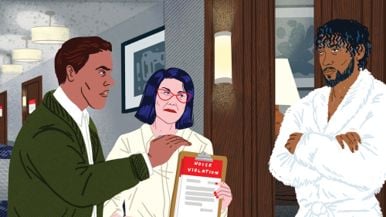
Honour among thieves: the only way to get the best selection of television shows and movies is to steal them

(Image: Andrew B. Myers)

My wife and I have cut the cord. Instead of a cable TV subscription, we have a laptop, which is connected to our flat screen LCD television, which we control while lying in bed with a little remote I bought for $19 at the Apple Store. Through this clunky rig we plow through entire seasons of HBO shows in mere days. We watch new episodes of 30 Rock, minus the ads, on the night they air. When we watch a movie, it’s often a new release, still playing in theatres. Sometimes we watch a movie weeks before it hits theatres. If a friend recommends an obscure old film to me over a beer, I’ll look it up on the spot with my Android. Then, with a touch of my finger, it will be waiting for me at home, in high definition.


You may consider me to be a pirate who refuses to pay for his entertainment. That would be half-right. I do pirate the things I watch, but I also pay for them. I just pay the wrong people.

Each month, a U.S.-based company called Giganews charges $14.99 to my Visa card. This fee allows me to access something called Usenet (an online network similar to e-mail or Web forums), which sends me video files at blistering download speeds. I used to avoid piracy, mostly because it was inconvenient. Speed and selection were spotty, files would arrive grainy or in low resolution or with Norse dubbing. But the files I get through Giganews are carefully labelled and the selection is vast. I can even subscribe to my favourite shows so they’ll download automatically. The result is nothing short of amazing—a personalized television service that lets me watch exactly what I want at any time I like and on any screen I own. I no longer watch lousy shows just because they happen to be on.

Giganews isn’t exactly illegal, but it isn’t exactly legit either. It relies on the “common carrier” defence, meaning it’s merely the conduit through which users connect to a public archive where anyone can upload or download whatever they want—mostly copyrighted material. One thing I can be sure of: Giganews doesn’t share my money with the people who make the things I watch.

If they did, I’d be willing to pay more. In fact, I’d pay double. Maybe even triple, just so that if I ever met Tina Fey in person, I could look her in the eye with a clear conscience. But no legitimate service offers what Giganews offers—for any price. If I signed up for the best cable TV package Rogers provides, which costs $169.84 a month, I would get access to less content, and I would wait longer to get it—no more watching a movie at home while it’s still in theatres. The only way to get the largest selection, the highest resolution, the fastest downloads and the newest releases is to steal.

Now, if I were living in the U.S., I would have access to legitimate services like the ad-based TV and movie site Hulu, and for-pay services like Amazon Video on Demand, Blockbuster on Demand, iTunes TV rentals, and the original version of Netflix, which offers a healthy selection of shows and movies. Between a Netflix subscription and various rental fees, an American with my viewing habits can sidestep cable, without becoming a criminal, for about $30 a month. But in Canada, all of these video services are “geoblocked”—visitors with Canadian IP addresses are weeded out and denied access. We now have a Canadian version of Netflix, but its library is a poor cousin of the original, with less desirable shows that tend toward the obscure (fans of Animal Planet’s River Monsters are in luck). Canadians are unable to rent TV episodes from iTunes, and instead must “buy” them at three times the price (Americans can watch this week’s Simpsons for 99 cents; we pay $3.49). Our own TV networks offer some streaming video online, but not much, and always through their decidedly lousy and hard-to-navigate Web sites. Again: if we want to have the most current and convenient selection, we have to steal it.

So why can’t we get decent, legitimate Internet-based TV in Canada? The big telecom companies blame the sorry situation on licensing complications. Securing the digital rights for the Canadian market is a slow and costly process, but if we’re patient, they say, Canada will catch up eventually.

The truth is, there is little incentive for Canada’s television industry to get with the times. Canadian broadcasters choose to lag behind, and deliberately sit on the digital rights that are often thrown in by distributors who sell them broadcast rights to movies and TV shows. After all, why should a station like CityTV help Canadians watch 30 Rock on demand via a $7.99 Netflix-like subscription when we could watch it through a $64 cable subscription to Rogers, its parent company? Why not instead shun and starve upstarts like Netflix, or, better yet, actively sabotage them?

Recently, Rogers did just that. Two days after Netflix Canada was announced, Rogers drastically lowered customers’ monthly download caps. A popular plan offering 25 gigabytes of data was cut back to 15 gigs (roughly eight hours of HD video streamed through Netflix). By contrast, the giant American Internet provider Comcast provides 250 gigs under its cheapest plan. So while Netflix may seem a bargain to Canadians at $7.99 a month, if you’re on a 15-gig plan, once you’ve watched four movies you’ll pay $8 or so more per movie in “overage” fees—twice what it might cost you to rent a DVD. This could easily kill Netflix in Canada before it gains a foothold, and scare potential newcomers away from our market permanently. These are the kind of things that happen when your broadcaster and your cable company and your Internet provider are all the same guy. In a word, the problem in Canada is competition—or, more accurately, our lack of it.

Page 1 of 2Next »

162 Comments

Comment on this post

  1. Ha! The US already considers us a “rat’s nest of thieves and bootleggers, a pirate’s haven like China and Pakistan”, so we might was well take advantage of our reputation. Just sayin’

    March 14, 2011 at 2:21 pm | by Kim Kelln
  2. Bravo Jesse! Took the words right out of my brain. I cut my cable in Oct 2009. I tend to watch podcasts and stream video from the crappy TV-network websites, rather than watching illegally obtained material, but I’m not above it. Our household generally “tries out” shows by pirating a few episodes; if we like it, we tend to go buy it on DVD. We just cut out the middleman.

    March 14, 2011 at 2:23 pm | by Krash Coarse
  3. Well Jesse, at least you acknowledge that what you’re doing is stealing. Most pirates won’t even do that. But your argument is really just a sad attempt to justify your theft.

    Are you really surprised that the movies in theatre are not available on Netflix? Please.

    March 14, 2011 at 3:03 pm | by Quentin
  4. “Consider you a pirate”? No – you are. Buying stolen goods is illegal in Canada. No different than buying stolen DVDs displayed on a blanket. Someone stole a thing of value belonging to someone else, then you bought it from him. True the deals are better in the US but that is ZERO moral justification. Lots of things are better deals in the US but you wouldn’t condone buying those off the back of a truck I’m sure (at least I hope not).

    March 14, 2011 at 3:08 pm | by Moderate
  5. Do you realize that the real victims of your civil disobedience will be creators? The thousands of people who work in the domestic film and television industries in Canada? The telecoms won’t be hurt by this. Just the independent filmmakers and documentary producers who can no longer get financing for their work because there’s no return on investment in Canada. Oh, and the huge ecosystem of professionals who work on their projects. Way to go.

    March 14, 2011 at 3:12 pm | by Amy
  6. You are a pirate. Actually you’re a thief. What if another writer took this article you wrote, sold it to another publication under his/her name and then made money off it, without a cent going to you – would that be ok? Even if it was ‘inconvenient’ for the other writer to write his/her original story? I’m deeply appalled that one creator would blatantly use, in an unauthorized manner, another creator’s work. I’m even more disturbed that Toronto Life let this article be published. I’ll be re-thinking my subscription.

    March 14, 2011 at 3:21 pm | by schan2011
  7. wow, a blazing display of smug self-satisfaction … a blatant disregard for compensating the artists responsible for the content which Mr. Brown consumes … maybe he’ll never meet Tina Fey and need to hang his head in shame, but perhaps colleagues at the CBC might want to stare him down in the hallway. pathetic.

    March 14, 2011 at 3:23 pm | by Twinkie
  8. I agree fully with this article. Telecom in Canada is a disaster, it is overpriced and offers incredibly poor service. I am not surprised that the author has turned to piracy. As he mentions, he’d be willing to pay if the services were actually available. Giving in to Rogers and Bell won’t solve the problem!

    March 14, 2011 at 3:34 pm | by razmataz
  9. Wow. Openly advocating theft in Toronto Life. Very disappointing and more that a little disturbing.

    March 14, 2011 at 3:35 pm | by Rich
  10. What is sad is that the writer outlines exactly how he is stealing and yet Canada’s laws for the protection of digital intellectual property are so outdated there is nothing that can be done to stop him.

    March 14, 2011 at 3:41 pm | by Carter
  11. You said it yourself, you are a thief. Regardless of what is being stolen, stealing is stealing. And stealing is illegal. The logic you use to justify your actions is pathetic. You may equate stealing movies and TV shows with stealing a few jelly beans, but I highly doubt the creators of that content would agree. I know I don’t. In my mind, a life or death situation is the only thing that might legitimately justify stealing. I would hardly call your need to watch the newest episode of 30 Rock at the same time it is airing, but without commercials, a life or death situation.

    March 14, 2011 at 3:44 pm | by cabma
  12. I applaud you for admitting that you and your wife are thieves. Using your logic, I am going pick a restaurant from the Toronto Life guide, take my wife out for dinner and skip out on the bill.

    March 14, 2011 at 3:45 pm | by Stephen Coady
  13. @Jesse

    Great opinion piece. I don’t think what you’re looking for will ever be permitted by the companies who own the content. Simplifying access to content is key.

    Live Shows (eg.Awards, Sports, etc) are still difficult to deal with outside of Cable’s grasp. But, adding a free OTA dish to your set-up and using Windows Media Centre as the primary interface gives you a little more access at minimal extra cost (only setup costs.)

    Oh, and you might want to try Newshosting. Reliable, fast, 30 connections, $5 cheaper per month.

    March 14, 2011 at 3:46 pm | by nihir
  14. This is a crazy article. Suggesting it is ok for people other than those directly involved in the creation to profit from online sales. I understand the perspective. We have all heard the cliche of a spoiled rich kid saying “I want a pony and I want it now”. I guess this guy is just so spoiled by a wonderful selection of amazing pieces of art that he feels he owns it already and is fine with paying third parties for delivering him what is not available. Even if those third parties are committing cutting out the artist. It floors me that everyone wants to cut out the record company because they are “going to rip off artists”. In watching this debate rage I see that this clown is ripping off artists and creators. It seems to me that the only group who has protected rights of creators are labels and film distributors. They take a cut and pay a cut. With streaming movie sites Google sells and ad and keeps all the money for themselves. Is at somehow cool with us?

    March 14, 2011 at 3:48 pm | by Jeff Rogs
  15. I think this is an interesting dilemma caused by a lack of clear up to date laws in Canada. We need legitimate ways to get copyrighted material that pay the rights holder and we need laws to back that up. But ISP’s in Canada do have a huge amount of control and are pushing out legitimate competition but I don’t think piracy is the answer.

    March 14, 2011 at 3:50 pm | by Alexavla

Comment on this post

Neither the author nor Toronto Life necessarily agrees with the comments posted here. Editors will not correct spelling or grammar. Toronto Life reserves the right to edit or delete comments entirely. Read our full policy


Follow Toronto Life on Twitter, Facebook and via RSS

Advertisement

Advertisement

Advertisement

Most shared stories today

Advertisement