Advertisement

Toronto Life - The Informer

The discerning mediavore’s take on the news of the day, from city hall to Power Ball

A Message from Toronto Life

28 Comments

Get a sneak peek at Philip Preville’s Toronto Life September issue cover story “Exodus to the Burbs”

Brian Porter and Carrie Low thought they’d hatched the perfect plan to avoid the eight-lane gridlock they faced every week on their drive to the family cottage in the Kawarthas. Porter, a soft-spoken 41-year-old Toronto firefighter, would arrange his work schedule to be home on Friday. He’d pack the car at noon and pick up his daughters, Lily and Amelia, from daycare shortly after lunch. Then, rather than head from their home in the Beach to pick up Low downtown, he’d drive to a strategic pit stop in Oshawa. Low, a slim 41-year-old redhead, works as a lawyer with RBC in the financial district, her days and nights packed, respectively, with meetings and paperwork. Her role in the escape plan was to get off work early and catch the GO train to Oshawa Station. Often, she’d end up working a pressure-packed day until 5 p.m. anyway, leaving Porter and the girls waiting at the station for hours. In the end they never gained that much time—it could still be a challenge to get to the cottage before nightfall. But at least they’d avoided the worst hours on the DVP and the 401.
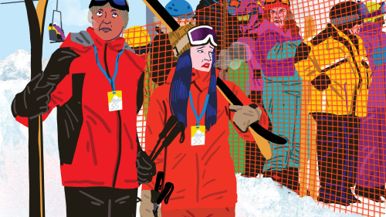
Porter and Low’s weekend escape strategy was symptomatic of their over-engineered city lives. To juggle all their needs and obligations—two careers, mortgage payments, bills, kid drop-offs and pickups, groceries, meals—they had built a life that resembled a Rube Goldberg machine, and any misstep threatened to collapse the entire contraption. Grandparents were often called in to shuttle the kids to lessons and play dates and birthday parties. “My mother-in-law would phone me at work and ask, ‘Where is Amelia’s dance outfit?’ and my stress level would go through the roof, ” recalls Low. “I’d say, ‘Why are you calling me at work for this? It’s in the house somewhere. Don’t ask me, ask Brian.’”

The problem, they decided, was not each other or their careers or their kids, but the city itself—a surprising diagnosis given that they had both grown up in Toronto, happily, in the Beach. They bought their 1,600-square-foot detached home on Benlamond because they wanted to raise their family there, too. But living in the city required too many contortions. They decided to divorce it.

Read the whole thing in our September issue, available in our digital edition or on newsstands

28 Comments

Comment on this post

  1. Good, go!!

    August 16, 2011 at 11:19 am | by Pauline
  2. Yeah, I read the article – when he’s in the big city he litters, walks and drives like a jerk because he’s anonymous. Sorry, but how you act when you’re anonymous is your true personality – this guy must be a treat when he’s vacationing. Good riddance!

    August 16, 2011 at 12:08 pm | by Shawn
  3. Don’t let the door hit you …

    August 16, 2011 at 1:03 pm | by Welshgrrl
  4. There are good & bad people everywhere…Life is what you make of it, and if the place you reside is bringing out your ugly side, well that’s easy, leave…I say good for you for taking that step and moving forward.
    Where you live does NOT define who you are as a person.

    August 16, 2011 at 3:59 pm | by T.ObornNowGone
  5. Sadly, the people who are moving to these towns are the ones who are spoiling it for everyone – including themselves. We moved to an older neighbourhood in Milton back when it was still a small town of 30,000. And yes, it took a while to get used to strangers actually making eye contact or even (gasp!) saying ‘Good morning!’ as they passed on the sidewalk.

    Now of course, Milton is a bloated exurb of nearly 90,000, and nobody in those new developments would piss on your house if it was on fire. They didn’t flee the city for the warm, friendly neighbours – they fled so they wouldn’t have to have actual contact with anyone different from themselves ever again.

    August 16, 2011 at 4:49 pm | by UrbanExile
  6. We moved to Toronto from Pickering 4 years ago and so far haven’t looked back. Pickering is typical of many suburbs – large homes on small lots with few community amenities. We actually spend less time in the car now because of the proximity to stores and restaurants, and have become younger at heart. Certainly not for everyone but it’s working for us now.

    August 16, 2011 at 8:29 pm | by Left the suburbs
  7. It’s obvious the author of this piece is clueless when it comes to Toronto.

    August 16, 2011 at 11:09 pm | by Bubba
  8. Looking out from his airplane on his first foray outside the iron curtain, as a young apparatchik of the defunct Soviet Union, Mikhail Gorbachev was struck by the endless miles of suburbs stretching from San Francisco to San Jose to Sacramento. The next day he had his chauffeur drive for hours through curvy residential streets. A few days later he hired a helicopter to get a look at back yards, shopping malls, freeways, industrial parks. Twenty years later the Cold War was over.

    Unfortunately for Gorby, if you look at Google satellite, Moscow and St. Petersburg are still surrounded by hectares of cubic gray three-story no-elevator pre-1970 apartment blocks, now complemented by L-shaped and I-shaped eight-story ones. Sure, there are a few luxurious estates out-of-town for the well-connected, but no sprawling subdivisions of duplexes and single-family dwellings, i.e. no robust middle class.

    The relative size of suburbs says something about a society’s ability to generate and distribute wealth. India, the world’s largest democracy, is rapidly growing its own version of suburbs. China, despite all its wealth, is unable. It remains a country with just a few million rich people, a billion very poor ones, and no peaceful political means of rectifying that. Probably 65% of the world’s population would describe Toronto-area suburbs as heaven on Earth. Another 30% would describe them as a nice place to live. I find it hilariously and insular-ly Canadian that we would even debate the merits of suburbs.

    August 17, 2011 at 11:10 pm | by Andrew
  9. Toronto has long failed to manage urban sprawl, which has stretched services thinly across too wide an area.

    People are forced into cars when they live beyond reasonable transit service. Try standing at a bus stop in the suburbs, hauling groceries, after work, in January.

    But, too many suburbanites still work in (and depend on) “the city” for their livelihoods. And, especially for those who’ve quit the 416 for the 905 and have taken their property tax support out of 416, they still put wear and tear on 416 roads, and then complain about construction.

    How did the 401 become the busiest highway in North America when cities like New York and Los Angeles (that doesn’t even have a subway) are twice as big? http://torontomyway.blogspot.com/2010/01/choking-on-congestion-talk_07.html

    And, statistics show urbanites are healthier than suburbanites http://torontomyway.blogspot.com/2010/05/health-and-city.html Which makes sense, doesn’t it? After all, everything is about the car in the suburbs, while urban dwelling supports not only choice but healthier choices, such as walking, cycling, or using public transit. How about using Bixi? http://torontomyway.blogspot.com/2010/05/bixi.html, http://torontoist.com/2011/05/bixi_toronto_is_here.php Would that fly in the suburbs?

    It ought to go without saying that the total cost of an overburdened health care system could be reduced for everyone if people got healthier, and it is easier to get – or stay – healthy in the city. This family who was stressed out – because their weekly drive to their cottage required so much administration – are part of a privileged minority; most Torontonians don’t have the luxury of the “problem” of how to get to and from a cottage every week. Good for them, if moving out to 905 reduces their stress but, on the whole,
    as indicated in the research, the urban encouragement and access to healthier choices provide the stress-busters that car-trapped commuters simply don’t have.

    Christopher Hume has a great article on density that continues to build on the knowledge we really do have about what makes urban living sustainable, and suburban living unsustainable http://www.thestar.com/columnists/article/887233

    Why not discover the joys of the city by walking or, as Hume calls it, the lost art of “strolling”? http://torontomyway.blogspot.com/2010/01/walk-walk.html

    Toronto My Way

    August 18, 2011 at 10:57 am | by Toronto My Way
  10. To me the main flaw in this article is describing these small towns as “suburbs”. This goes to show the writer has yet to leave behind his “centre of the universe” Toronto mentality.

    Dundas and Creemore are certainly not suburbs of Toronto.

    We moved our family from Toronto’s east end to Kitchener-Waterloo 5 years ago because the price of real estate would have had a negative effect on our family (two full time working parents, day care, no holidays, struggling to get by, etc.) and while we miss some things about the city, including the wonderful restaurants, it has been an overwhelming positive experience for our family and my career. I’ve started a thriving business since moving to the 519.

    We fell smack-dab in the middle of the writer’s “no way, we’re urban” mentality, and our friends were appalled on the whole, but believe me, South-Western Ontario has a whole lot more to offer than the GTA, we’re very happy with our move to downtown Kitchener.

    It seems to me, as a regular visitor and ex-pat of Toronto, that long-term, the city is only viable for the childless or uber-rich. This is too bad, but maybe a reality of larger cities.

    August 18, 2011 at 10:26 pm | by Ben Hagon
  11. Not to change the subject, but I’ll do it anyway — Toronto My Way should perhaps be aware that Los Angeles does indeed have a subway / light rail network that’s growing by the year. And people are riding it. A link between Downtown and the beach in Santa Monica is half-way done. Beverly Hills is getting some stops on the extension of the Wilshire line. Times change….

    http://www.metro.net/riding_metro/maps/images/rail_map_future.gif

    August 18, 2011 at 10:51 pm | by TOLA
  12. Strange article to be on the cover of Toronto Life. Also I think it is clear that the opposite is happening. Toronto is becoming significantly more dense as a city, most people are not deserting the city. Nevertheless Toronto is certainly is not for everyone and I wish the author good luck. The piece was clearly an attempt on his part to justify a difficult liife decision that he was having dificulty coming to terms with. Very weak piece overall, with a few random interviews to justify his point, which he was clearly struggling with.

    August 19, 2011 at 8:12 pm | by Ian b
  13. Tiresome, self-absorbed wiener decides to inflict his douchebaggery Peterborough, pretends this represents a trend of some kind, convinces gullible Toronto Life underlings likewise, sells yet another version of a hackneyed cliche that appears in TL about every 36 months. Elderly controlled-circulation TL recipients yawn at cover, fail to read story. And so it goes.

    August 21, 2011 at 7:24 pm | by JJ Hunsecker
  14. @TOLA, thx for the correction, I definitely should be aware of LA’s system and now I am, thanks to you.

    As you mention that it’s “growing by the year” and that “people are riding it,” I’d hasten to argue that its coverage and growth both put TTC to shame. It’s quite likely that the LA Metro – in addition to the road network – directly help control the sheer number of cars that have to be on the road.

    Compare their airport access http://www.metro.net/riding_metro/maps/images/airport_map.pdf vs. ours http://www3.ttc.ca/Riding_the_TTC/Airport_service.jsp, http://www.torontopearson.com/en/toandfrom/ and its easy to see how behind we are.

    While my facts stood some correction, the point I was making is only stronger – the good that Toronto offers is being mismanaged chiefly by poor planning.

    August 23, 2011 at 10:26 am | by Toronto My Way
  15. As others have mentioned: I wonder about someone who litters, etc. when he’s anonymous. Obviously he didn’t see himself as part of Toronto The Good at all. No matter where you live you have to spend some time thinking of the greater good and not just what you can get away with. I moved to Toronto 15 years ago (from Vancouver) and have found it to quite a friendly, inclusive place. My home. And because of that, I don’t litter when no-one is watching. ;)

    August 23, 2011 at 3:55 pm | by johnd126

Comment on this post

Neither the author nor Toronto Life necessarily agrees with the comments posted here. Editors will not correct spelling or grammar. Toronto Life reserves the right to edit or delete comments entirely. Read our full policy


Follow Toronto Life on Twitter, Facebook and via RSS

Advertisement

Advertisement

Advertisement

Most shared stories today

Advertisement