While we’re busy teaching our kids to tend school gardens, they’re failing provincial tests in reading, writing and math. The folly of the new enviro-propaganda

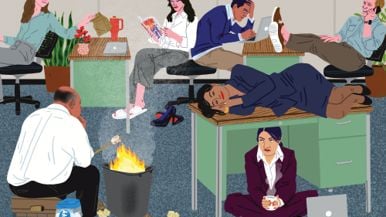
(Illustration: Tavis Coburn)
This fall, hundreds of Toronto students are harvesting beets and zucchini from their school gardens. I say: nice photo op, bad idea. The argument for school gardens assumes that by grubbing in the dirt, kids will learn to love eating vegetables. They won’t think chickens hatch into this world as deep-fried nuggets. And they’ll develop a respect for nature.


Here’s the counter-argument: our students shouldn’t be out scrabbling in the hot sun when one in five can’t pass the Grade 10 literacy test administered by the provincially funded Education Quality and Accountability Office. And while Canadian students score high internationally in reading, mathematics and the sciences, Statistics Canada says our relative ranking is declining due to improved performance by other countries. In this era of global competition, we can’t afford to let other nations nip at our heels.
Half of Toronto’s population was born outside Canada, and it’s a safe bet many of them came here for a better life, including a good education for their offspring. A lot of immigrants originate from agrarian regions of countries such as India, Pakistan, China and the Philippines. The last thing these newcomers need is a morality crusade about carrots. Yet more than 200 of Toronto’s nearly 600 public schools now have gardens, and an army of well-meaning parents, volunteers, activists and advocacy organizations with a social agenda is successfully lobbying for more.
The schools I’ve visited tell me that growing your own food is worthy, wholesome and educational. That’s what Chairman Mao said when he shipped millions of Chinese youth to the countryside—and abandoned them there. I know whereof I speak. I moved to China in 1972, at the height of the Cultural Revolution. As a third-generation Canadian, I didn’t speak Chinese. I knew only what my profs at McGill University had taught me: that China was a revolutionary utopia.
At Beijing University, where I studied Mandarin and Chinese history, I enthusiastically embraced Maoism, including the precept that students must “reform” their wayward thinking through physical labour. It was, to put it delicately, horticultural hell. My classmates and I harvested wheat and hauled pig manure and dug ditches. At one point, we marched 20 kilometres to a farm, where we tilled the land for nearly a year. It being the silly ’70s, McGill gave me full credit toward my Asian history degree, and I graduated on schedule. Intensive farm work, however, vaporized my Chinese classmates’ one precious chance at an education. Today, they’re called China’s Lost Generation.
Mao’s agrarian fantasy and the Cultural Revolution sputtered to an end with the Great Helmsman’s death in 1976. China immediately relaunched its vaunted education system, with rigour. This past year, Shanghai beat the rest of the world in reading, math and science in standardized tests managed by the Organization for Economic Co-operation and Development.
So it’s alarmingly déjà vu to see the gardening campaign underway at so many Toronto schools, both public and private, even if it’s a far more touchy-feely version. Toronto Waldorf School, where tuition and fees exceed $16,000 a year in the higher grades, is an enthusiastic proponent of whole-earth education. It has a chicken coop, a few goats and a $150,000 organic greenhouse that recycles grey water. A farming and gardening program, centered on its three-acre teaching garden, is an integrated part of the curriculum from Grade 3 through Grade 9. Ninth graders spend three weeks living and working on organic farms, some as far away as Europe.


JAN WONG IS JOKE. Clearly she only writes such rubbish to grab attention and get people all worked up. If she really believes the crap she writes than I feel sorry for her having such a small mind and heart. Toronto life is also a joke for hiring this fool.
October 6, 2011 at 6:52 pm | by JordanHow can such fallacies even be published? Since when does one person’s narrow-minded prejudices get so much attention?
Jan Wong obviously knows very little about the Ontario curriculum, for instance that environmental education is part of every grade’s expectations for the year. There is also extensive research to support that the use of gardens supports imagination, which helps brain development and the use of higher order thinking skills.
Anyway, thank you Cat Davis for eloquently articulating a well informed argument. Let’s think about the whole child here, being able to pass a test only proves that the child is able to write a test well.
October 7, 2011 at 11:10 am | by @sarlowesJan Wong Gets it Wrong:
October 7, 2011 at 11:49 am | by Ryan Lindsay, Toronto Waldorf SchoolJan Wong tried very hard to correlate Toronto Waldorf School’s award-winning farming curriculum with the mediocre literacy results of some Ontario public schools, but, while conducting her interview with me, failed to even ask how our students actually measure up. Here’s the answer: TWS students have a 100% pass rate with the Grade 10 Ontario EQAO Literacy Test. While few schools actually have farming (or other hands-on) curricula and do not have 100% pass rates, TWS students excel in literacy precisely because they are engaged in such a rich, integrated academic program. It is partly due to the farming, woodwork, handwork, movement, art, music, French and German classes that blend with literature, math, science, history, etc. at TWS that students are able to build both the will to work long and hard and the interdisciplinary thinking capacities to attain deeper comprehension of complex material. Students from Toronto Waldorf School are so well versed in writing and reading that they would never have written such a sensationalist article based on missing facts and a false premise. No wonder other schools are now borrowing the Waldorf curriculum. Please feel free to contact me again to get the facts straight so you can print a correction.
An important part of inteligence is to establish proper priorities. On teh basis of this article Jan Wong has demonstated that she is an idiot.
Twice over. There s this business of going to China in the 1970 for a utopian experience.
Nor does she take responsibility. She blames her McGill professors for inspiring her to go to China.
October 10, 2011 at 11:18 am | by Charles ArymowiczThis is quite a rant about a program that demonstrably has been so good for Toronto kids in so many ways. It’s too bad Ms. Wong doesn’t think being outside, getting exercise doing something that’s actually productive, improving landscapes, learning some important ecological principles, applying measuring and planning skills to a real space, and working cooperatively on something real is good education. She’s not telling us that art or music or physical education or drama or any other “hands-on” types of school activities prevent students from achieving desirable test scores – so this piece unfortunately reads like a personal vendetta against memories of hard Mao times.
It would be good if Ms. Wong would do a little homework on the usefulness of education that integrates some of education’s basic reading, writing and numeracy skills into applied personal skills-learning. She might also take a look at the changing world out there that globalization has wrought: our style of education for “the economy,” for a cog job (no personal skills), a credit card, and consumption as success is wreaking havoc on the natural world. (This is not propaganda or ideology, it’s the very well-documented science we would do well ensure our children are taught.)
Being in physical contact with nature in a school garden can help children begin to understand the importance of biodiversity (and habitats), of mitigating climate change (growing food and eating locally and organically is one very big fossil-fuel-emissionss-reducing idea), and of the pleasure of knowing how to do real things (pulling your first carrot is an unforgettable moment!).
How I would have loved to have someone show me how to fix a toilet (or anything) in school. Maybe I would have found education that fretted about all those boring tests more interesting and relevant!
We need to educate our children for sustainability now, Ms. Wong, and school gardening is one of the must successful “new” (to us) ways of integrating important principles with knowledge and skill. Bravo to Ms. Harrison, to Bendale and to the Eco-Schools programs that are finally letting children expand their learning beyond the boxes of the classroom and specialist reductionist curricula and getting a feel – and a taste – of the real world they will have to face.
October 10, 2011 at 4:18 pm | by EHI was irked by Jan Wong’s correlation between horticultural initiatives and low standard test scores. I was outright appalled by her ridiculous analogy between Maoist China and school gardens. That is the most absurd thing I have read in years, and I am disgusted by the fact that T.O life is wasting money on this garbage. Journalism is meant to be supported by fact, not be scattered with ridiculous claims and outlandish correlations. Comparing a bunch of Torontonian kids at a school learning about the importance of nature for a few hours a week to slavery, and dictatorial rule is absolutely dumb. It’s poor journalism, it’s weak writing, and honestly I would not buy T.O life again after reading this nonsense.
October 13, 2011 at 10:57 pm | by D MoodleyJan Wong’s ‘investigative’ journalism seems out of place in Toronto Life. As the intellectual heir of Lubor J. Zink, she would find more supportive readers at the Toronto Sun.
October 28, 2011 at 10:41 am | by jhSo by default, what I’m getting from this article is:
1. Farming is not “worthy, wholesome and educational.” It’s insidiously communist.
2. “Scrabbling in the hot sun,” should be left to uneducated peasants or profit-driven multinational food companies because learning to grow food offers no intrinsic value.
3. Schools and teachers are utterly incapable of teaching multiple subjects because pinko gardening & arts programs are directly responsible for low test scores and poor academic performance in business-friendly maths and sciences. Funny given this NYTimes story on Tech Execs who choose to send their kids to garden-friendly Waldorf: http://www.nytimes.com/2011/10/23/technology/at-waldorf-school-in-silicon-valley-technology-can-wait.html?_r=2&pagewanted=1&hp
What a load of manure!
December 6, 2011 at 1:16 am | by J. ZimmermanJust a quick reminder that aspects of all of the subjects taught in the classroom can be taught through gardening. Gardening can become a valuable outdoor classroom where the children are more stimulated to learn, by seeing the practical applications of the lessons taught in the classroom. I know I always learned much better when I saw the practical applications to subjects I was learning. As well, having fun while learning a lesson has been proven to be a helpful in the retention of the subject matter. Kids, go garden – and teachers, make the very most out of it you can!
February 3, 2012 at 9:45 pm | by Lisa Hart