In an experimental procedure at Toronto Western Hospital, surgeons drill holes into a patient’s skull, slide rods deep into the tissue, and send an electrical current to the frontal lobe. It’s used to treat depression, Alzheimer’s, obsessive-compulsive disorder and even obesity. Someday, it could also reveal the darkest secrets of the brain

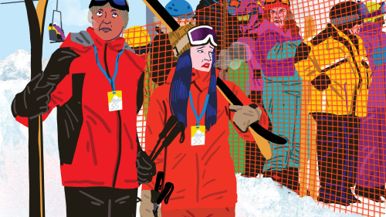
Shock tactics: The battery pack and electrodes that stimulate Debra Prupas’s brain often set off store alarms at the mall
When she was eight years old, Debra Prupas realized there was something wrong with her. She felt a heaviness, like she was enclosed by a fog, and wanted to lie in bed and do nothing for days in a row. The feeling passed, but it returned many times throughout her life.
Prupas, now a 52-year-old litigator at the Toronto office of the Department of Justice, didn’t consider getting help until 1991, after a breakup with a boyfriend. Her psychiatrist diagnosed her with chronic depression and prescribed small doses of Prozac. It worked at first, but the heaviness crept back. She was given other drugs: sertraline, trazodone, mirtazapine, vanlafaxine, phenelzine, bupropion, nefazodone, norpramin, citalopram and paroxetine. The psychiatrist tried to enhance the effects of the medications with lithium. Some regimens would brighten her mood for several months, but inevitably her depression would return. “It was like somebody turned the lights down,” she says. “Colours would literally fade.”
She went to a new psychiatrist, who recommended electroconvulsive therapy. At first she was reluctant, remembering the treatments in One Flew Over the Cuckoo’s Nest and worrying about the possibility that the procedure would leave gaps in her memory. Over four weeks, Prupas subjected herself to a dozen electrically induced seizures. They didn’t work.
By 2005, her condition had grown more serious. She couldn’t get out of bed and would miss work for days on end. Commitments would pile up on her—it was too much effort to shower, to dress, to take the streetcar to her downtown office tower, to ride the elevator to the 33rd floor, to answer e-mails. She began to think about suicide as a solution.
And then she heard about a study at Toronto Western Hospital—an experimental brain surgery for people with severe depression. The process, called deep brain stimulation, was risky, but the possibility of relief was tantalizing. She couldn’t keep going the way things were. Prupas signed up to be considered for the trial. At the beginning of 2006, she got the call: she’d been accepted.
Deep brain stimulation was first studied in the U.S. in the 1940s as an alternative to pre-frontal lobotomy. It was later tested on rats in Montreal, as part of an attempt to counter severe pain by targeting pleasure centres in the brain. The procedure involves inserting electrodes into the brain and sending an electric current to target areas, changing the way neurons behave. Although no one knows exactly how it works, the current can modulate activity in those zones. The rats got so much satisfaction from zapping themselves by stepping on levers that they stopped doing anything else and died of starvation. In the 1960s, DBS was used on cancer patients, and it helped alleviate pain in certain cases. Then, in the 1970s, neuroscientists started wondering whether it could help people with movement disorders, such as Parkinsonian tremor. The common practice for Parkinson’s patients who weren’t responding to drugs was to cut or burn a spot in the brain that was known to be causing problems. However, if the surgeon missed the target, any adverse effects were permanent. DBS, on the other hand, although just as invasive, is largely reversible. If the electrical current causes an unwanted reaction, you can simply turn it off.


Related
Related Tags
cancer, Drugs, Health, hospitals, technology, Toronto, Trials
Popular
Most Commented